Bosch's Garden of Earthly Delights at the Prado
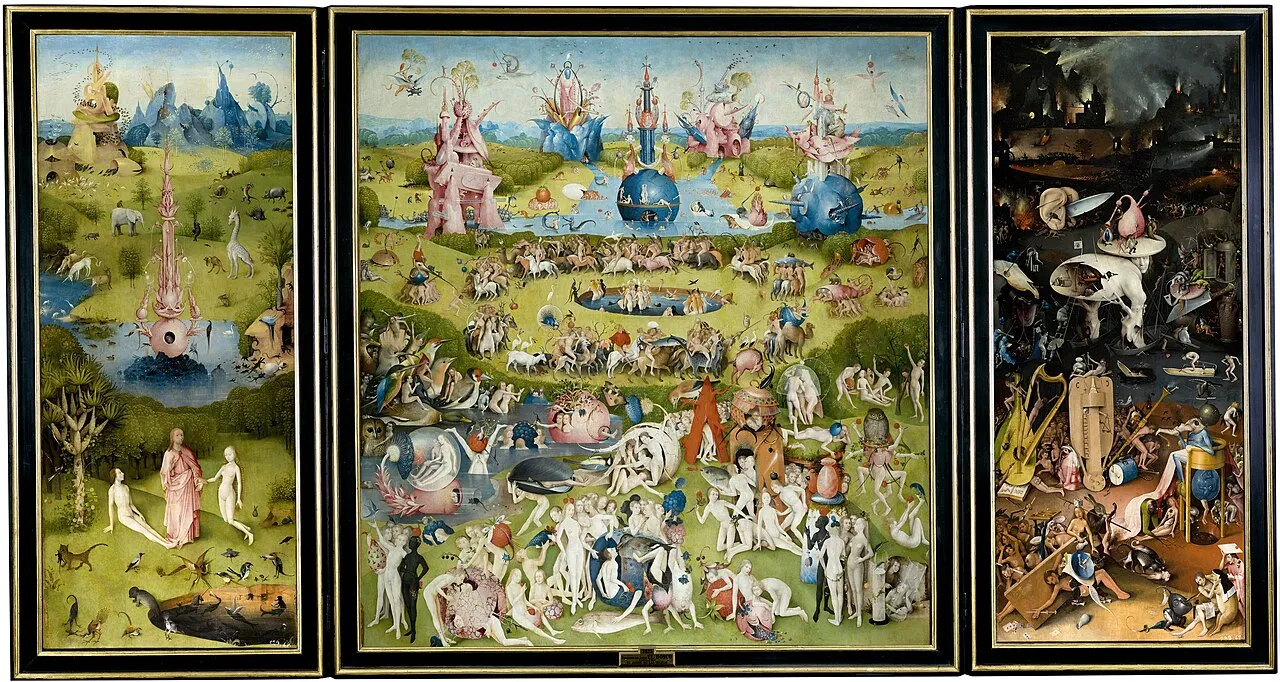
Few works in the history of art generate as many questions as answers. The Garden of Earthly Delights, painted by Hieronymus Bosch between 1490 and 1510, is the most enigmatic, the most debated and perhaps the most fascinating of them all. A triptych nearly four metres wide that depicts paradise, carnal pleasure and hell with an imagination that has neither precedents nor direct successors in all of Western painting. The Prado Museum displays it in room 056A, and every year tens of thousands of people stand before it with the same question on their lips: what does it all mean?
Bosch and his world: s'-Hertogenbosch, 15th century
Jheronimus van Aken, known as Bosch after his home city, s'-Hertogenbosch (or Den Bosch, in present-day Netherlands), lived from around 1450 to 1516. He was a member of the Brotherhood of Our Lady, an élite religious confraternity in his city, and painted mainly for the bourgeoisie and nobility of the Burgundian Netherlands.
His work is utterly singular in the context of 15th-century Flemish painting. While his contemporaries — Jan van Eyck, Rogier van der Weyden, Hans Memling — were developing a meticulous realism centred on the human figure and landscape, Bosch populated his compositions with hybrid creatures, demons, monsters and nightmare landscapes that have no equivalent in any other painter of his time.
What makes Bosch even more enigmatic is that his visionary obsession was adored by Philip II of Spain, the most austere, most Catholic and most fearsome monarch of the 16th century. The king accumulated twenty-eight works by the Flemish painter — including The Garden of Earthly Delights — and hung them in his private apartments. That choice baffled people then and continues to baffle them today.
The triptych: structure and function
A triptych is a work made up of three hinged panels: two side panels that can be folded over the central one, like the doors of a cabinet. When closed, the triptych forms a single visual unit; when opened, it reveals the three interior scenes.
In the case of The Garden of Earthly Delights:
- Outer panels (triptych closed): The Earth on the third day of Creation, painted in grisaille (grey tones imitating sculpture). A transparent sphere containing a world still without colour, without animal life, without sin. God the Father appears in the upper left corner. The Latin inscription from Psalm 33:9 — Ipse dixit, et facta sunt (He spoke, and it came to be) — underscores the initial moment of Creation.
- Left panel (Paradise): The Creation of Eve and the Garden of Eden. Adam, Eve and God the Father in a lush landscape filled with exotic and fantastical animals — giraffes, elephants, hybrid creatures — around a central fountain. Bosch's Paradise is not a bucolic meadow: it already contains the seeds of what is to come; the monsters lurking at the margins of Paradise foreshadow the Fall.
- Central panel (The Garden of Earthly Delights): The largest and most disconcerting panel. Hundreds of naked figures — men, women, people of different races — give themselves over to pleasure among giant fruits, fantastical creatures and impossible architecture. The colour is festive, almost euphoric; the tone, ambiguous between celebration and warning. A circular procession of riders surrounds a central pool; at the margins, couples hide inside shells and flowers.
- Right panel (The Musical Hell): The darkest panel. A nocturnal hell illuminated by fires, in which the damned are tortured by their own sins. A man is devoured and vomited up by a monstrous creature. A pair of giant ears pierced by an arrow destroys everything in their path. And, at the centre, one of the most celebrated images in the triptych: the Tree Man, a figure whose torso is the hollow trunk of a tree, with boat-like legs sunk in ice and a head turned into the stage for a demonic revels. A figure many interpret as Bosch himself observing his own creation.
The central panel: pleasure or condemnation?
The great question about the central panel is whether the scenes depicted are sinful or innocent. For centuries, the dominant interpretation was moralistic: The Garden of Earthly Delights would be a warning about the dangers of lust and carnal pleasures, with Hell as the logical consequence. Paradise shows original innocence; the central panel, the corruption of that innocence; Hell, the inevitable punishment.
But that reading does not fully explain the absence of expressions of guilt or shame in the figures of the central panel. The naked figures do not look like trapped sinners: they appear free, joyful, given over to a world of sensations without consequences. Some art historians have proposed alternative interpretations:
- The central panel might represent humanity before the original sin: a hypothetical state in which Adam and Eve had not fallen and sexuality was innocent, without guilt.
- The work might be a document of a heretical sect — the Adamites, who practised naked rituals in imitation of Edenic innocence — whose beliefs Bosch illustrated in cryptic form.
- The triptych might be an alchemical work, with transformation symbolism that only the initiated could decipher.
None of these theories is definitive, and that is precisely the inexhaustible fascination of the work: it resists all interpretations without being exhausted by any.
The Musical Hell: instruments as torture
The right panel of the triptych deserves particular attention. Bosch imagines Hell as a place where musical instruments — lute, harp, flute, drum — become instruments of torture. A man is crucified on a harp; another is devoured and expelled by a giant bird that defecates on him in a pit of darkness; a naked couple is wrapped in the strings of a lute.
Music — which in the Middle Ages was considered both a divine gift and a diabolical temptation — acquires its most menacing aspect here. American art historian Craig Wright identified in 2014 a piece of musical notation written on the buttocks of a damned figure in the lower panel. A New Zealand musician transcribed and recorded it: the result is a Gregorian melody that sounds, paradoxically, serene.
The Tree Man at the centre of the infernal panel has generated a critical literature almost as extensive as that of the triptych as a whole. His gaze towards the viewer, his posture as a passive observer in the midst of chaos, and the revelry taking place on the dish he balances on his head make him one of the most enigmatic figures in all of Western painting.
Other Flemish works at the Prado: Bosch beyond the Garden
Room 056A and the adjacent Flemish painting rooms (rooms 055–058) hold other important works by Bosch and his contemporaries that deserve attention:
- The Table of the Seven Deadly Sins (c. 1505–1510, Bosch): A circular painting showing the seven deadly sins around the eye of God, with the motto Cave, cave, Deus videt. It also belonged to Philip II.
- The Haywain (c. 1515, Bosch): A triptych in which the world hurls itself in tumult at a cart of hay — a symbol of vanity and fleeting goods — being pulled towards Hell. Angels and demons surround the scene from the sky.
- The Adoration of the Magi (c. 1494, Bosch): A triptych of more conventional composition but with the characteristic fantastical details and crowds of tiny figures that are Bosch's hallmark.
- The Descent from the Cross (c. 1435, Rogier van der Weyden, room 058): The most important Flemish painting at the Prado outside Bosch. A composition of overwhelming emotional intensity, with ten life-size figures around the body of Christ being lowered from the cross.
Discover Bosch with an expert guide
A guided tour of the Prado takes you to Bosch's room with all the keys to reading The Garden of Earthly Delights: the three panels, the symbolism, the figures and why it so fascinated Philip II.
See Prado guided tour →⏳ Time-slot places are limited. Lock in your time · non-refundable, double-check your dates.
Room 056A: what the experience is like today
Room 056A of the Prado has been specifically designed to house the triptych. The work occupies an entire wall and can be seen from a considerable distance, allowing visitors to take in the overall composition before moving closer to the details. The lighting is calibrated so that the colours of the central panel — greens, pinks, translucent blues — are displayed at their full intensity.
To make the most of the visit, it helps to:
- Start with the outer panels. When closed, the triptych shows the grisaille of Creation. In the museum it is displayed open, but the grisaille Earth panel is reproduced in an explanatory mural nearby.
- Read the triptych from left to right. Paradise → Garden of Earthly Delights → Hell. The narrative suggested by this chronological reading — innocence, fall, damnation — is the most recognisable, though not the only possible one.
- Linger on the Hell panel. It is the darkest and most densely detailed. The Tree Man, the score on the damned figure's buttocks and the giant ears are just three of the hundreds of details that populate that scene.
Practical tips for seeing The Garden of Earthly Delights
- Allow at least 30 minutes in this room alone. The triptych has a density of detail that requires time. Two or three passes — first from a distance, then up close, then from a distance again — allow you to discover new things each time.
- Bring binoculars or use your phone's zoom. Some details are so small that they are difficult to see with the naked eye. A zoom or a pair of opera glasses reveals surprising details.
- Also see The Haywain. It is in the same room and completes the picture of Bosch as a moral narrator of human sin.
- Book in advance. The museum opens at 10:00. Free evening slots (18:00–20:00 Monday to Saturday; 17:00–19:00 Sundays and public holidays) allow you to visit without ticket-office queues.
Frequently asked questions about The Garden of Earthly Delights
What does The Garden of Earthly Delights represent?
A triptych showing Paradise (left panel), the world given over to carnal pleasure (central panel) and Hell (right panel). Its exact meaning is still debated: moral, alchemical and heretical interpretations coexist without any being definitive.
Which room is it in at the Prado?
Room 056A, ground floor of the Villanueva building, alongside other works by Bosch and 15th- and 16th-century Flemish painting.
How large is the triptych?
The central panel measures 220 × 195 cm; each side panel 220 × 97 cm. When open, the triptych is nearly four metres wide.
Why is it at the Prado and not in the Netherlands?
It arrived in Spain in the 16th century, passed to Philip II and was at El Escorial until 1939, when it was transferred to the Prado.
What is the Tree Man in the Hell panel?
A figure whose torso is a hollow tree, with legs like boats sunk in ice and a head turned into the stage for a demonic revels. Some interpret him as a self-portrait of Bosch himself.
Standing before The Garden of Earthly Delights, the first reaction is usually one of disbelief: how could a 15th-century painter have imagined a world like this? The second, on moving closer to the details, is not wanting to leave.
Content reviewed by the Ticket Visit team · September 2026.