Las Meninas by Velázquez at the Prado
Some paintings hold a mystery that no amount of analysis can exhaust. Las Meninas by Diego Velázquez, painted in 1656 in the Royal Alcázar of Madrid, may be the greatest of those mysteries: a seemingly everyday scene — the Infanta Margarita surrounded by her ladies in the royal apartments — that becomes a radical meditation on painting, the gaze and the representation of power. It is no coincidence that the philosopher Michel Foucault devoted the opening pages of The Order of Things (1966) to this work: it is a painting that thinks.
The painting and its moment: Madrid, 1656
Diego Rodríguez de Silva y Velázquez was, in 1656, the most powerful painter in Europe. Born in Seville in 1599, he had served the Spanish Crown for almost thirty years as Philip IV's court painter and held the prestigious post of Royal Chamberlain. He knew the Alcázar in Madrid like no one else: its rooms, its inhabitants, its rituals of protocol and its plays of light. Las Meninas is the mature fruit of that intimate acquaintance with power and painting.
The painting was made for the king's apartments in the Alcázar — the Pieza del Príncipe, where Velázquez had his studio — and was inventoried for the first time in 1666, ten years after the artist's death. It is not known exactly how long Velázquez spent on it, but the technical mastery and conceptual density of the work suggest a long and deliberate process.
The composition: what is happening in the scene?
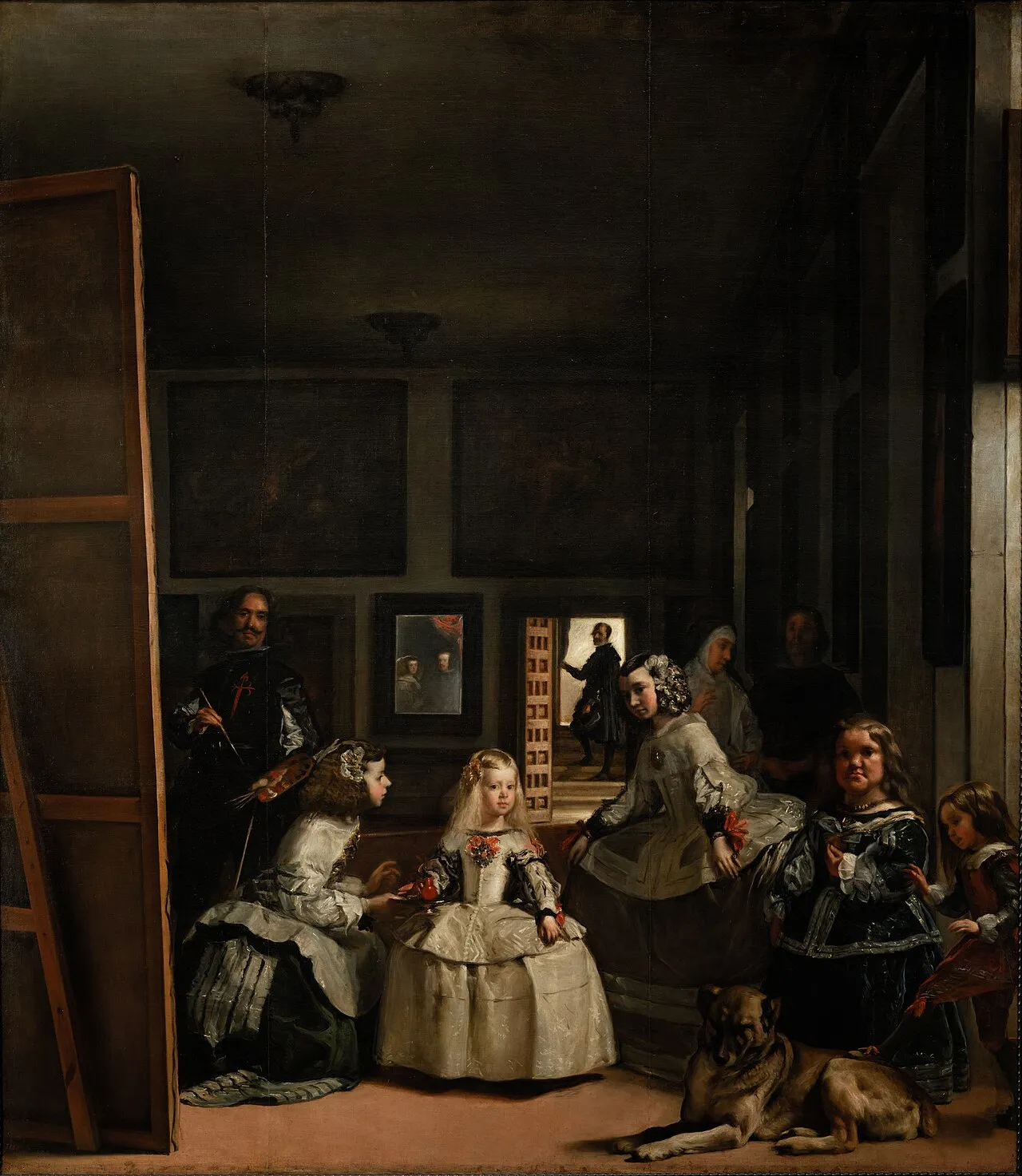
At first glance, Las Meninas shows a court scene. At the centre of the composition, the Infanta Margarita of Austria — daughter of Philip IV and Mariana of Austria, then five years old — is offered a clay vessel by one of her ladies. The scene has the immediacy of a captured instant: the Infanta looks towards us, or towards something outside the picture.
But the scene is far more complex:
- Velázquez himself appears on the left, before a huge canvas whose reverse we can see, brush in hand and also looking out of the picture. The artist has represented himself at work. On his chest he wears the cross of Santiago, which according to tradition was added by royal order a few years after the painter's death.
- The meninas (the Infanta's ladies-in-waiting) flank Margarita: on her right, Doña María Agustina Sarmiento offers her the vessel; on her left, Doña Isabel de Velasco makes a curtsy.
- Maribárbola and Nicolasito Pertusato, the court dwarfs, occupy the far right. The dwarf nudges with his foot a mastiff lying in the foreground.
- In the background, a mirror on the wall reflects the busts of King Philip IV and Queen Mariana of Austria. They are the only figures whose image appears indirectly: they are where we are, in the viewer's space.
- In the doorway at the back, framed by illuminated steps, the Royal Chamberlain José Nieto Velázquez — a namesake of the painter — turns or enters, suspended in a threshold between inside and outside.
The mirror and the visual trap
The mirror at the back is the most debated element of Las Meninas. What exactly does it reflect? There are two main interpretations. The first, and most widely accepted, holds that the mirror reflects the king and queen, who are posing for Velázquez in the space in front of the painting — that is, the same place we occupy. The second proposes that the mirror does not reflect real space but the large canvas Velázquez is painting: the monarchs would already be portrayed on that invisible canvas.
Whichever interpretation is correct, the effect is the same: the viewer is drawn into the scene. If the king and queen are where we stand, then it is we who are watching and being watched. The Infanta, Velázquez and the other figures are looking at us. The painting becomes a two-way mirror, and the line between inside and outside the canvas dissolves.
The light: the true protagonist
Velázquez was the European master of natural light. In Las Meninas, the illumination comes from three sources: the open window to the right (outside the canvas but visible through the light it casts), the windows at the back, and the open door through which Nieto enters. This light — warm, lateral, Mediterranean — models the volumes with extraordinary subtlety and creates an atmosphere of verisimilitude that no contemporary could match.
Velázquez's technique in Las Meninas is also revolutionary: loose, almost Impressionist brushstrokes in some details — the Infanta's hair, the reflections in the mirror, the jewels — contrast with areas of greater definition in the faces. From a distance, the painting "works" like reality; up close, it reveals itself as a prodigy of abstraction. The French artist Édouard Manet, who saw it at the Prado in 1865, declared it "the painting of paintings".
Why is it the masterpiece of Spanish painting?
Las Meninas condenses everything that makes Velázquez great: direct observation of reality, absolute technical mastery, the ability to capture the instant and the philosophical depth that turns a court portrait into a meditation on the nature of art. But it also transcends the artist.
In the 20th century, Las Meninas inspired one of Picasso's most ambitious series: in 1957, confined to his studio in Cannes, Picasso painted 58 variations on Las Meninas in three and a half months, breaking down Velázquez's composition using the Cubist language. That dialogue between the two great geniuses of Spanish painting, separated by three centuries, is one of the most exciting in the history of art. Picasso's variations are housed in the Museu Picasso in Barcelona.
The painting has also captivated image-makers, photographers and film directors: its mise en abyme structure — the painting within the painting, the mirror reflecting what we cannot see — anticipates contemporary debates about representation, authorship and the gaze that remain entirely relevant today.
Visit Las Meninas with an expert guide
A guided tour of the Prado takes you directly to room 012 and explains every detail of Las Meninas: the mirror, the light, the figures and why this painting has continued to fascinate experts for over 370 years.
See Prado guided tours →⏳ Time-slot places are limited. Lock in your time · non-refundable, double-check your dates.
Room 012: what the experience is like today
Room 012 of the Prado Museum is one of the largest in the museum. Las Meninas occupies the back wall on its own, and the space is designed so that visitors can view the painting from various distances. A few metres away, the sense of presence is overwhelming: the figures are almost life-size and the Infanta's gaze seems to follow you around the room.
The Prado recommends standing about three or four metres away for the correct perspective. Too close, and Velázquez's loose brushwork becomes apparent; at the right distance, everything merges into a scene of almost photographic coherence.
The room also houses other great canvases by Velázquez: The Spinners and The Surrender of Breda are in adjacent rooms, so a visit to this corner of the museum offers a complete immersion in the Sevillian painter's world.
Practical tips for seeing Las Meninas
- Arrive first thing. Room 012 is always busy. Being among the first in (the museum opens at 10:00) allows you to see the painting without crowds during the first few minutes.
- Take your time. Allow at least 20–30 minutes in this room alone. Look for the mirror, follow the directions of the gazes, try to locate every figure.
- View it from different distances. At 1 metre you can see the loose brushwork; at 4–5 metres you see how everything fits together. Both experiences are distinct and complementary.
- Also visit The Spinners. A few metres from room 012, The Spinners is almost as ambitious and complex as Las Meninas, and far less crowded.
- Book your ticket in advance. In high season (summer, Easter, bank holiday weekends) tickets for specific time slots sell out. Booking online avoids queues and guarantees access.
Las Meninas: what to look at up close
We have stood in front of the painting several times. Beyond the theory, these are the details that are really worth seeking out once you are face to face with it in room 012.
- Velázquez's self-portrait. On the left, brush raised, the cross of Santiago on his chest. Watch his gaze: he is not painting the infanta, he is painting you.
- The mirror at the back. It is small and easy to miss, but King Philip IV and Mariana of Austria are reflected in it. Step close enough to make out the two blurred faces.
- The perspective and the light. Stand 3–4 metres back: from there the scene "clicks", and the lit doorway at the rear, with Nieto on the threshold, opens the room outward.
- Don't leave without seeing the neighbouring works. A few steps away are The Surrender of Breda and The Spinners, also by Velázquez and far less crowded.

Travellers who book, visit and double-check every detail against official sources. Last reviewed: September 2026. Been to the Prado? Tell us about your visit →
Frequently asked questions about Las Meninas
Which room is Las Meninas in at the Prado?
Room 012 of the Prado Museum, ground floor of the Villanueva building. It is one of the largest and most recognisable rooms in the museum.
Who appears in Las Meninas?
The Infanta Margarita of Austria, her ladies-in-waiting (meninas), Velázquez himself painting, the dwarfs Maribárbola and Nicolasito, the chamberlain Nieto at the back, and the reflection of King Philip IV and Queen Mariana of Austria in the mirror.
Why did Velázquez paint himself in Las Meninas?
Depicting himself in a scene of the royal family was a statement about the artist's status: Velázquez was asserting painting as a noble art, not a manual trade. It also adds a philosophical dimension to the work, turning it into a reflection on what it means to paint and to look.
What does the mirror in Las Meninas reflect?
The mirror reflects the busts of King Philip IV and Queen Mariana of Austria. According to the most widely accepted interpretation, the monarchs are located in the space in front of the painting, the same position occupied by the viewer.
What is the best time to see Las Meninas?
First thing in the morning (opening at 10:00) on weekdays, or during the free evening slots (Monday to Saturday 18:00–20:00; Sundays 17:00–19:00).
When you walk into room 012 and find the Infanta Margarita looking directly at you, the feeling is unmistakable: the painting does not merely depict a scene — it recreates it each time someone stands before it.
Content reviewed by the Ticket Visit team · September 2026.