Prado Masterpieces: the essential collection
The Prado Museum is the world's greatest repository of European painting from the 15th to the 19th century. More than twenty thousand works — around seventeen hundred of which are on display in its galleries — form a unique collection built up over centuries by the Spanish Crown: Charles I, Philip II, Philip IV, Charles IV… each monarch added his own layers. The result is a museum that cannot be seen in a single day, but whose essential works can be explored in a well-organised morning.
How the Prado collection is organised
The Prado's collection is spread across three floors of the Villanueva building and the rooms of the Jerónimos cloister. The organisation is primarily chronological and by national school:
- Ground floor: Velázquez and 17th-century Spanish painting (rooms 009–016), 15th- and 16th-century Flemish painting, Bosch (rooms 056A–058), classical sculpture and Italian painting.
- First floor: Titian and the Venetian school, El Greco, Rubens and 17th-century Flemish painting, Murillo and Zurbarán, Goya (rooms 032–044 and 064–067).
- Second floor: Fra Angelico, Raphael and the Italian Renaissance, Dürer, Spanish painting of the 18th and 19th centuries.
- Jerónimos cloister: temporary exhibitions and some works on loan.
Velázquez: the Sevillian genius of room 012
Diego Velázquez (Seville, 1599 – Madrid, 1660) is the central artist of the Prado and, for many critics, the greatest European painter of all time. The museum holds his most complete body of work: from the Sevillian still lifes of his youth to the great portrait masterpieces of his maturity.
The essential works:
- Las Meninas (1656, room 012): The crowning achievement of Spanish painting and one of the most discussed works in the entire history of art. A labyrinthine composition depicting the Infanta Margarita, her ladies, the court dwarfs, Velázquez himself and the reflection of the monarchs in a mirror. The single work that has generated more pages of art criticism in the Western tradition than any other.
- The Spinners (c. 1657, room 009): A scene of tapestry-making at the Royal Tapestry Factory in Madrid that conceals, in the illuminated background, a reference to the myth of Arachne. Velázquez's second great conceptual work, less visited than Las Meninas but equally fascinating.
- The Surrender of Breda (1635, room 009): Also known as The Lances, this is Velázquez's most ambitious history painting. The Spanish general Ambrosio Spínola receives the keys of the Dutch city of Breda from the defeated commander with a generosity unusual in the war painting of the period.
Goya: from the court to the Black Paintings
Francisco de Goya (Fuendetodos, 1746 – Bordeaux, 1828) is the other great name at the Prado, the painter who connects the 18th century with modernity. The museum holds the largest and most complete collection of Goya in the world, with works ranging from the luminous tapestry cartoons of his youth to the terrifying Black Paintings of his old age.
- The Nude Maja and The Clothed Maja (c. 1797–1800 and c. 1800–1808, room 036): Two canvases conceived as a pair. The Nude Maja scandalised the Spanish Inquisition — it was one of the paintings that prompted an investigation into Goya — for being one of the first non-mythological female nudes in Spanish painting.
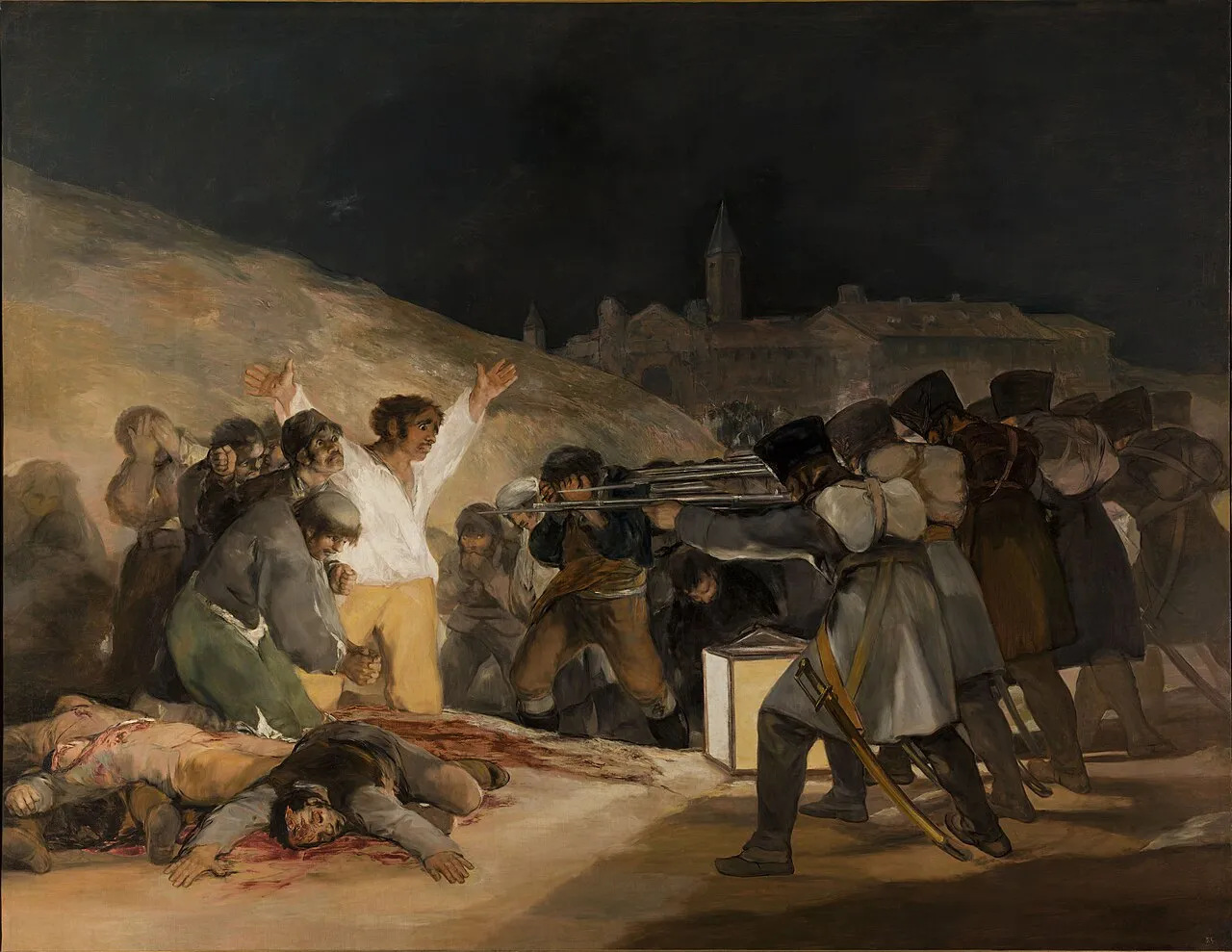
- The Third of May 1808 (1814, room 064): The most powerful condemnation of the execution of civilians that art has ever produced. A man in a white shirt raises his arms before a firing squad in a gesture that distils all the helplessness and horror of war.
- The Family of Charles IV (1800, room 032): A group portrait that Goya turned into a merciless X-ray of power: the royal family appears as a wealthy bourgeoisie without grandeur, with expressions ranging from indifference to vacancy. Velázquez painted his monarchs as gods; Goya showed them as they were.
- Saturn Devouring His Son (1820–1823, room 067): The most disturbing of the Black Paintings. A titan with bulging eyes devours the body of one of his children. Goya painted this work directly on the walls of his house, the Quinta del Sordo, with no buyer in mind. It is a document of the psyche of a genius on the edge of the abyss.
El Greco: the visionary of Toledo
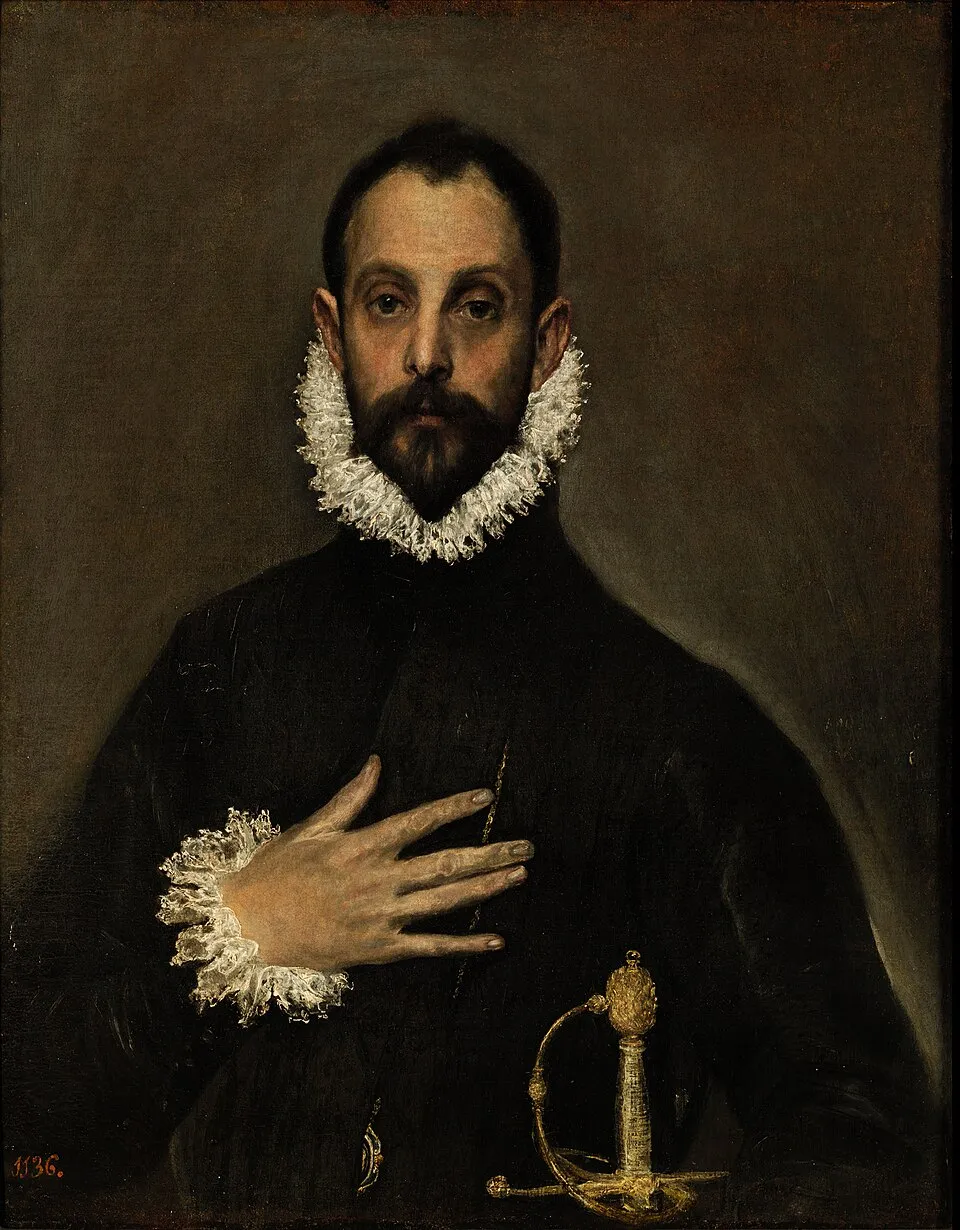
Doménikos Theotokópoulos, El Greco (Candia, Crete, c. 1541 – Toledo, 1614), arrived in Toledo in 1577 from Italy and developed there one of the most original styles of the late Renaissance: elongated figures, intense colours, unreal lights, compositions that seem on the verge of dissolving into the spiritual. The Prado holds over forty of his works, the world's largest public collection.
- The Trinity (1577–1579, room 009B): Painted for the altarpiece of the convent of Santo Domingo el Antiguo in Toledo, this large-format work shows God the Father holding the dead body of Christ surrounded by angels, in a composition of overwhelming spiritual power.
- The Knight with His Hand on His Breast (c. 1580, room 009B): The most mysterious and celebrated portrait by El Greco. A man in black rests his hand on his breast in a gesture of oath or loyalty; his identity remains an enigma. The intensity of the gaze and the perfection of the gesture make this one of the most memorable portraits in Spanish painting.
Bosch: the Flemish visionary
Jheronimus Bosch (s'-Hertogenbosch, c. 1450 – 1516) is the most enigmatic painter in the Prado's collection. His work — filled with fantastical creatures, sins, hells and paradises — was inexplicably adored by Philip II, the most austere and religious king in Spanish history. The monarch accumulated twenty-three paintings by Bosch, a large number of which entered the Prado.
- The Garden of Earthly Delights (c. 1490–1510, room 056A): The most ambitious and debated triptych in the entire history of art. The left panel shows Paradise; the central one, a phantasmagoria of naked figures abandoned to pleasure; the right, a musical and terrifying Hell. Centuries of interpretation have not exhausted its mystery.
- The Table of the Seven Deadly Sins (c. 1505–1510, room 056A): A circular painting representing the seven deadly sins around an all-seeing eye, with the motto Cave, cave, Deus videt (Beware, beware, God sees). It also belonged to Philip II.
Titian: the painter of emperors
Tiziano Vecellio (Pieve di Cadore, c. 1488/1490 – Venice, 1576) was the favourite painter of Charles I and Philip II. The Prado holds the largest collection of Titian outside Italy, with over forty works spanning his entire career.
- Charles I at the Battle of Mühlberg (1548, room 027): The most important equestrian portrait of the European Renaissance. The Emperor appears on horseback, in armour, at the sunset of the battle. The pose and the monumental scale of the format defined the state portrait for the centuries that followed.
- Venus with Cupid and the Organ Player (c. 1555, room 044): One of the mythological poesie Titian painted for Philip II. The reclining figure of Venus, the music and the Venetian landscape create one of the most sensual and melancholy images of the Renaissance.
Rubens: the Flemish exuberance of the 17th century
Peter Paul Rubens (Siegen, 1577 – Antwerp, 1640) was the most influential painter of the European Baroque and a diplomat who visited the Spanish court on two occasions. The Prado holds over ninety of his works.
- The Three Graces (c. 1630–1635, room 029): Rubens's pictorial testament. The three goddesses of charm — Aglaea, Euphrosyne and Thalia — embrace in an Arcadian landscape. The painting was bought by Philip IV at the painter's death and is the most sought-after Rubens at the Prado.
- The Garden of Love (c. 1633, room 029): A scene of courtly gallantry in which Rubens, by then elderly, painted himself alongside his young wife Hélène Fourment. A celebration of life and love in its purest state.
Dürer, Fra Angelico and Raphael: the masters of the North and the Italian Renaissance
The Prado's collection is not limited to Spanish and Flemish painting. It also holds works by the great German and Italian masters of the Renaissance:
- Albrecht Dürer: Self-Portrait (1498, room 055B): Painted when Dürer was twenty-seven, it is one of the earliest self-portraits in the history of painting in which the artist depicts himself as an elegant gentleman, on an equal social footing with his patrons. The detail of the lace and glove is already a demonstration of unparalleled technical virtuosity.
- Fra Angelico: The Annunciation (c. 1425–1428, room 049): The oldest panel in the Prado. The angel Gabriel announces to the Virgin Mary her maternity in a portico of arches reflecting the Florentine architecture of the early Renaissance. The chromatic purity and spiritual serenity of Fra Angelico are unmatched in 15th-century painting.
- Raphael: The Cardinal (c. 1510–1511, room 049): One of the most mysterious portraits of the Italian Renaissance. A cardinal with a penetrating gaze and an inscrutable expression whose identity has never been determined with certainty. The economy of means and the psychological intensity of the portrait place it among Raphael's finest works.
Discover the collection with a guide
The Prado's collection is so vast that a guided tour makes a real difference: it helps you navigate, connects the works to each other and ensures you don't miss the key pieces in the maze of galleries.
See Prado guided tours →⏳ Time-slot places are limited. Lock in your time · non-refundable, double-check your dates.
Frequently asked questions about the Prado collection
How many works does the Prado Museum hold?
Over 20,000 works in total; around 1,700 are on display in the galleries. The rest is kept in storage or lent to other institutions.
What is the most famous work at the Prado?
Las Meninas by Velázquez (1656) is the most celebrated and most visited work in the museum.
How long does it take to visit the Prado?
For the most important works, between two and a half and three hours. A two-hour guided tour covers the essentials with context.
Which El Greco works are at the Prado?
The Prado holds the world's largest public collection of El Greco, with over forty works. The highlights are The Trinity and The Knight with His Hand on His Breast.
Content reviewed by the Ticket Visit team · September 2026.