What to See at the Prado Museum: Essential Masterpieces
The Prado Museum houses one of the most important collections of European painting in the world, spanning from the Renaissance to the 19th century. From Las Meninas by Velázquez to the terrifying Black Paintings of Goya, here is a guide to the works you simply cannot miss.
1. Las Meninas by Velázquez (room 012) — the defining work
Las Meninas (1656) is the reason many travellers make the journey to the Prado Museum. Diego Velázquez portrayed the Infanta Margarita surrounded by her ladies-in-waiting, court dwarfs and other figures, with the painter himself gazing out at the viewer from within the canvas. The compositional complexity — the mirrors, the spatial depth, the interplay of glances — makes this work an inexhaustible visual enigma that has fascinated artists and philosophers for centuries.
It is displayed in room 012 of the Villanueva building, on the main floor. Arrive early or during the final hours of the day to enjoy it without crowds. The dimensions of the canvas (over 3 metres tall) and its compositional depth deserve time and attention.
Book your ticket or guided tour
A guided tour gives you the historical context of Las Meninas and the rest of the collection. Skip-the-line access and free cancellation.
See tickets and tours →⏳ Time-slot places are limited. Lock in your time · non-refundable, double-check your dates.
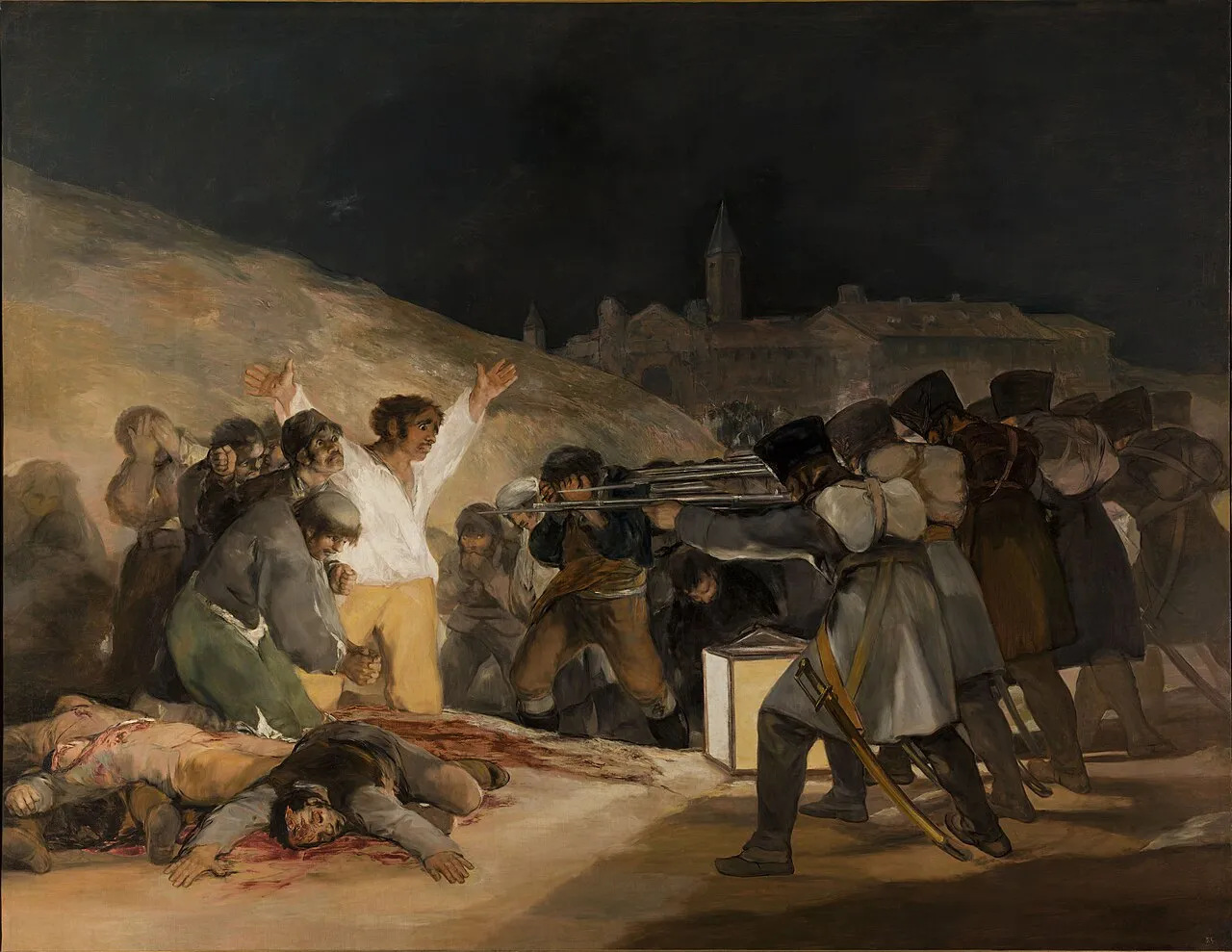
2. Goya: the Majas, The Third of May and the Black Paintings
Francisco de Goya is the great protagonist of the Prado and his works trace the full evolution of the artist. The Nude Maja and The Clothed Maja are striking for their boldness for the era: they are exhibited side by side and allow visitors to appreciate the difference in the treatment of skin and fabric. The Third of May 1808 is one of the most powerful images in the history of art, a protest against the violence of war painted with a brutal composition of light that anticipates modern art.
The Black Paintings, transferred from the Quinta del Sordo, are Goya's most disturbing and personal expression. Saturn Devouring His Son concentrates in its thick brushstrokes a visceral anguish that seems to leap out of the frame. These are works painted for no one, or for oneself alone.
3. The Garden of Earthly Delights by Bosch
The Garden of Earthly Delights (c. 1490–1510) is the most famous triptych by Hieronymus Bosch. The three panels unfold a fantastic and unsettling universe: Paradise with Adam and Eve, a human world filled with carnal pleasures and hybrid creatures, and Hell as a nightmare of tortures and darkness. The richness of detail is such that each viewing reveals something new. The Prado holds the world's finest collection of Bosch, and this triptych is its centrepiece.
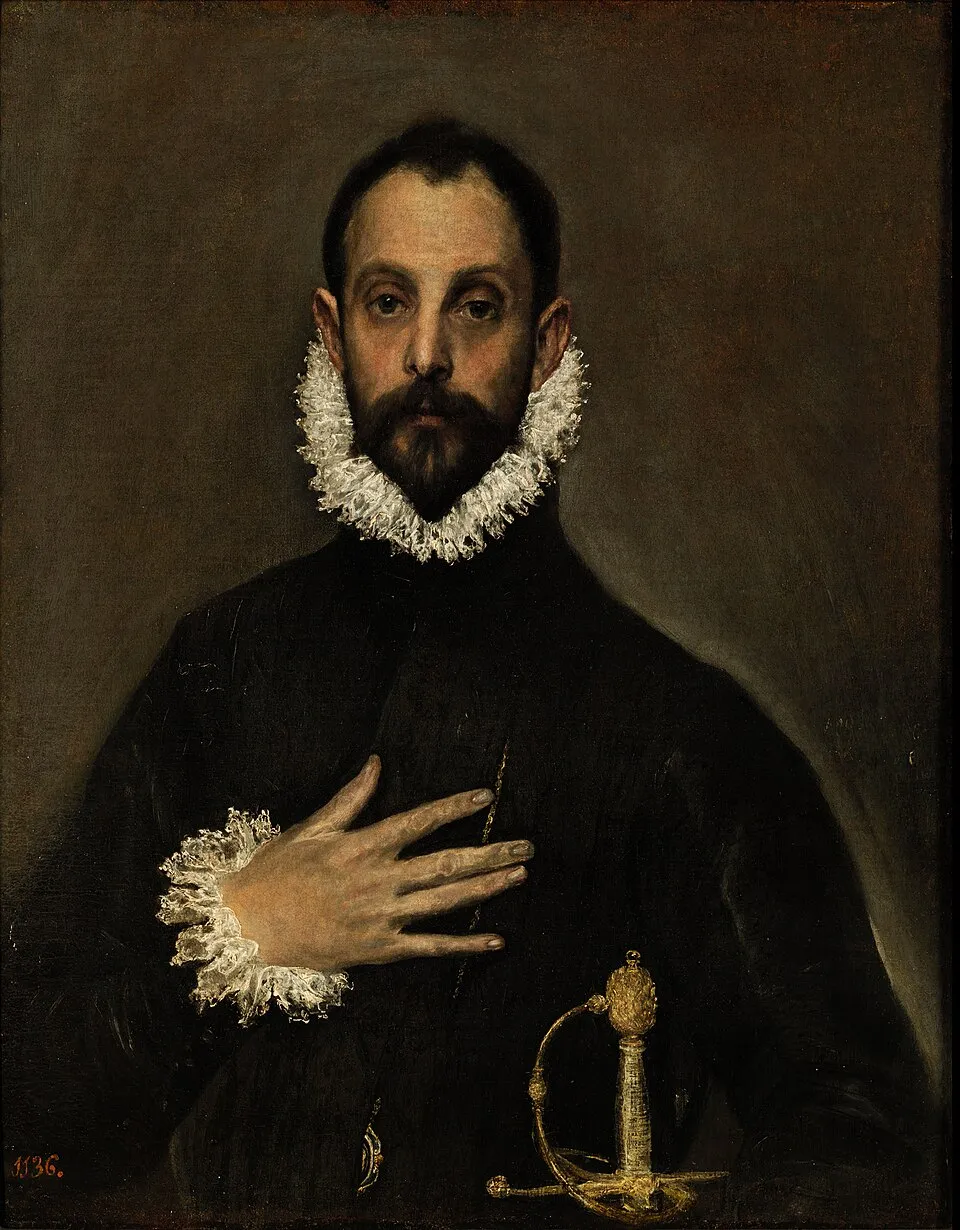
4. El Greco: The Knight with His Hand on His Breast
Domenikos Theotokopoulos, known as El Greco, developed in Toledo an unmistakable style of elongated figures, vibrant colours and intense spirituality. The Knight with His Hand on His Breast (c. 1580) is perhaps the most celebrated portrait in Spanish painting: an anonymous man with a solemn expression and direct gaze whose identity has intrigued historians for centuries. The Trinity showcases the most visionary side of the Cretan painter, with his characteristic elongated figures and palette of luminous cool tones.
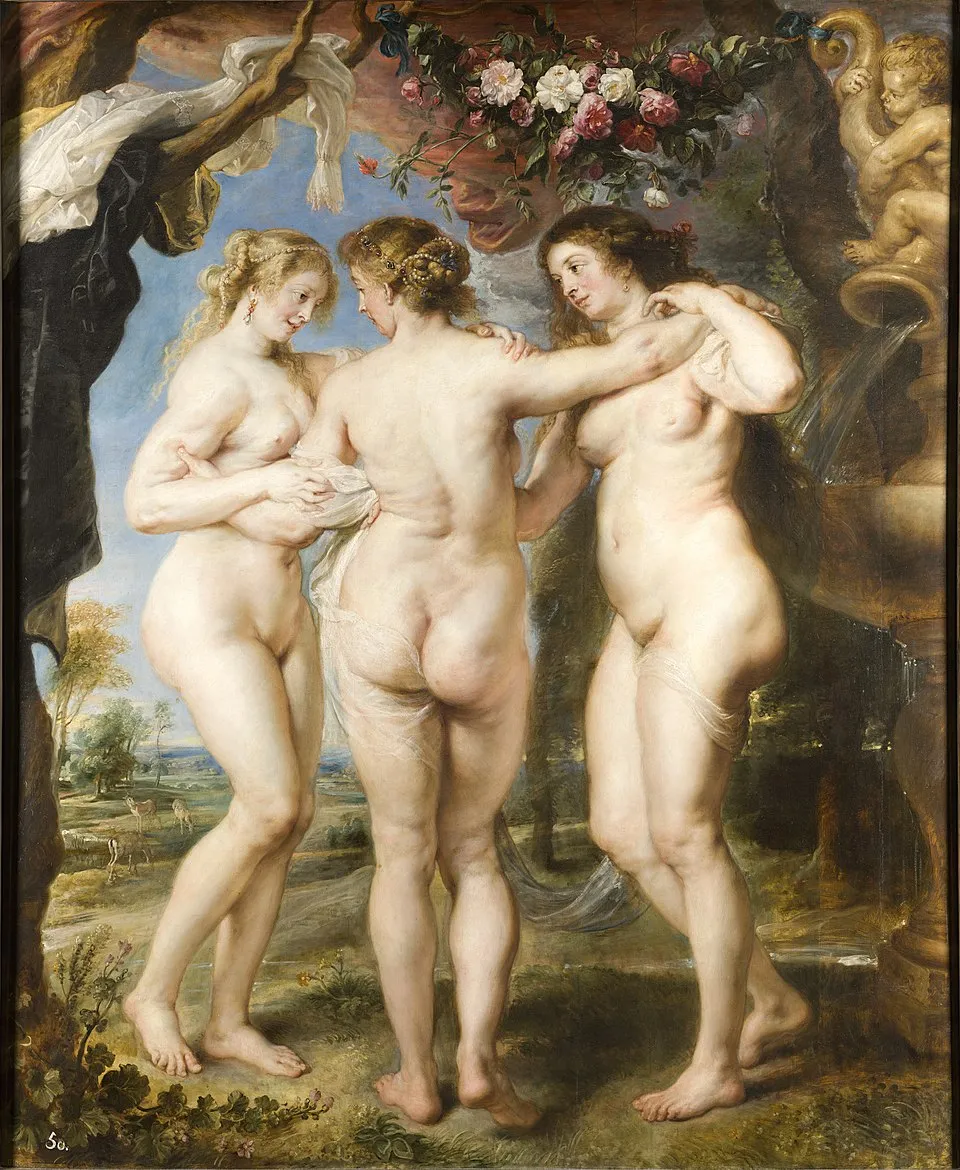
5. Rubens: The Three Graces
The Three Graces (c. 1630–1635) is one of the last great works by Peter Paul Rubens, painted for his own personal enjoyment and not commissioned by any patron. The three female figures — including a portrait of his second wife Hélène Fourment — display the carnality and joie de vivre characteristic of Flemish Baroque. The Prado's collection of Rubens is exceptional: King Philip IV was one of his main patrons.
6. Titian, Dürer and the great European schools
The Spanish royal collection accumulated works by the finest European masters over the centuries. Titian is represented by imperial portraits of Charles V and Philip II, as well as mythological compositions of exceptional sensuality and luminosity. Albrecht Dürer is present with his celebrated Self-Portrait (1498), one of the first known author paintings in Western history. Fra Angelico, Raphael, Tintoretto and Patinir complete a journey spanning the great Italian, Flemish and German schools of the Renaissance.
Suggested tour of the collection
The permanent collection is organised primarily in the Villanueva building by school and period. For a first visit, we recommend starting on the main floor, where Las Meninas and the major works by Velázquez are found, and then continuing through Goya's rooms on the first floor. Bosch occupies dedicated rooms on the ground floor alongside 15th- and 16th-century Flemish painting.
- Main floor, Velázquez: Las Meninas (room 012), The Spinners, The Surrender of Breda, portraits of the royal family.
- First floor, Goya: The Majas, The Third of May, The Family of Charles IV, the Black Paintings.
- Ground floor, Flemish painting: The Garden of Earthly Delights (Bosch), works by Patinir and Rubens.
- Main floor, European schools: El Greco, Titian, Dürer, Raphael, Fra Angelico.
Tips for your visit
- The museum opens Monday to Saturday 10:00–20:00 and Sundays and public holidays 10:00–19:00. It closes on 1 January, 1 May and 25 December.
- The last two hours of the day (Monday–Saturday 18:00–20:00; Sundays 17:00–19:00) offer free admission: there are more visitors, but it is a good option if you only want to see Las Meninas.
- Booking tickets in advance avoids queuing at the ticket office, especially in summer and at weekends.
- The cloakroom and luggage storage are on the ground floor. There is a café next to the Jerónimos cloister (Moneo extension).
Frequently asked questions about the works
Which room is Las Meninas by Velázquez in?
In room 012 of the Villanueva building, main floor. It is clearly signposted from the entrance.
How long does it take to visit the Prado Museum?
Seeing the essential works takes between 2 and 3 hours. To explore the entire permanent collection, set aside a full morning or afternoon.
Can you visit the Prado for free?
Yes. During free-admission hours (Monday–Saturday 18:00–20:00, Sundays and public holidays 17:00–19:00) you have access to the full collection at no cost.
Content reviewed by the Ticket Visit team · September 2026.
Keep planning your visit
Before you start, grab your skip-the-line ticket to the Prado to avoid the box-office queue.